
Brazilian Carlo
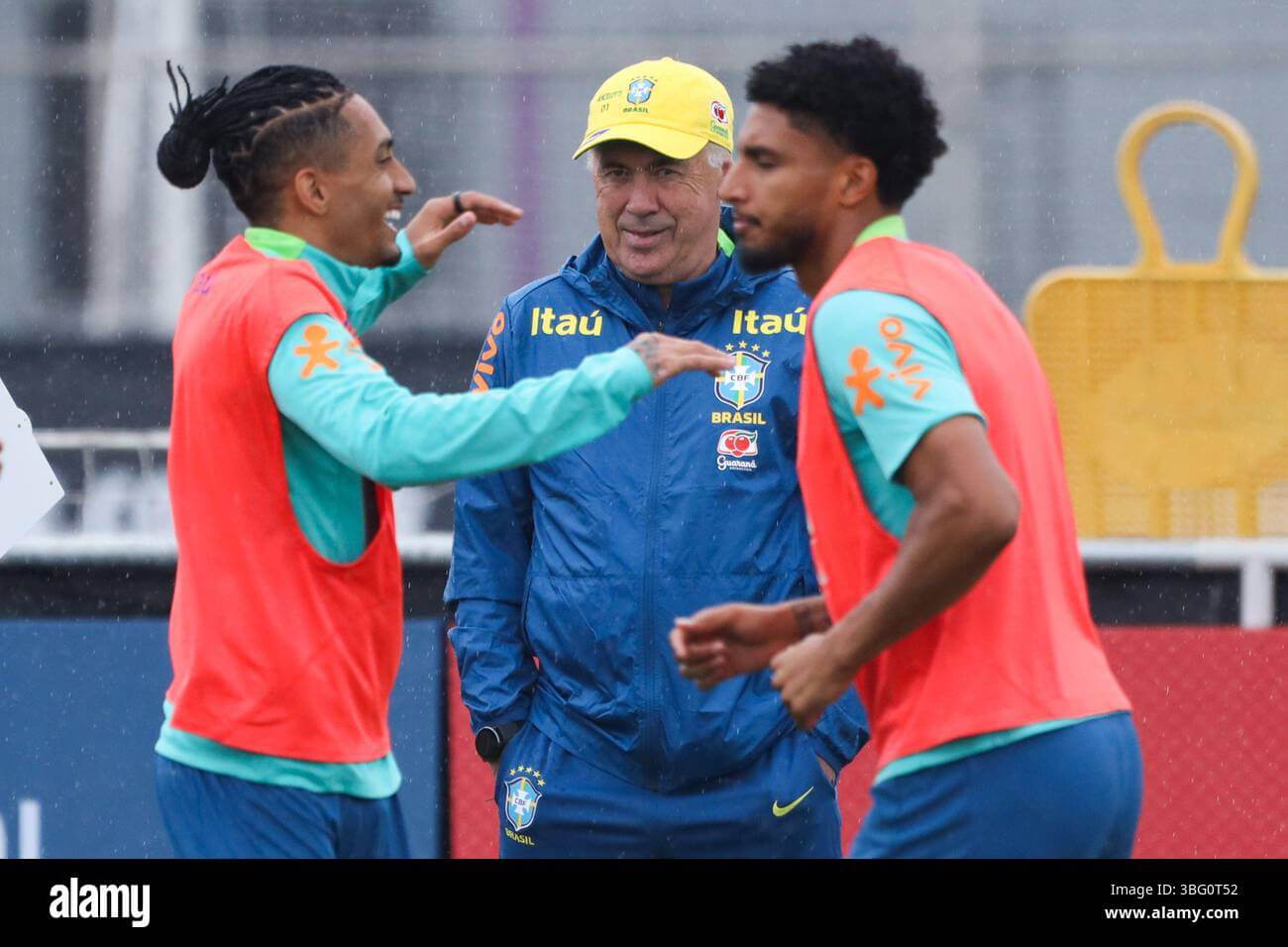
Carlo Ancelotti steps into the Brazil hot seat with the job of lifting the Samba Boys from their current crisis and making them challengers for the 2026 World Cup. Feargal Brennan gives the lowdown.
International jobs do not come much bigger than the one Carlo Ancelotti has landed himself as the veteran coach takes charge of the Brazil national team in June. Ancelotti’s exit from Real Madrid came about on the back of frustrating campaign for him in the Spanish capital as the Italian ended his second spell with Los Blancos in controversial circumstances.
The club’s reputation for ruthlessness was clear to see, as president Florentino Perez moved to replace Ancelotti before the season ended, with iconic former midfielder and Bayer Leverkusen boss Xabi Alonso breezing back into the Estadio Santiago Bernabeu.
The desire for a fresh start in Madrid provided a crucial knock-on impact for the Brazilian FA as the five-time World Cup winners finally secured their man. Brazil had seen a previous effort to lure Ancelotti fall short at the start of 2023 as they looked for an instant replacement for Tite, who stepped down after the World Cup in Qatar.
However, the door was never fully closed, as Brazil remained hopeful over luring Ancelotti and none of their short-term solutions delivered the required impact. Two caretaker stints for Ramon Menezes and Fernando Diniz changed little within the wider picture for Brazil, but the negative impact was reduced, with fans not expecting either coach to get the job on a permanent basis.
Diniz was entrusted with the start of qualification for the 2026 FIFA World Cup, but three defeats from their first six qualifiers forced a change at the beginning of 2024, as journeyman coach Dorival Junior took charge.
That was the first definitive move made by Brazil in the post-Tite era, but there was still the sensation of a stop-gap, despite having ‘permanent’ written at the top of his contract. His experience within domestic Brazilian football was heralded as a major positive, but results improved little, and he was sacked after March’s 4-1 defeat on the road at arch foes Argentina.
That result sealed Argentina’s place at the World Cup, and while there is no real danger of a collapse and Brazil missing out, the task ahead for Ancelotti cannot be understated. After all, this most celebrated of national teams is experiencing one of its worst ever sequences of results and their performance in qualifying has been so poor that had the competition not been expanded to 48 teams and more places available, they would have been scrapping to book their place in the United States, Canada, and Mexico.
Controversy over a historical move to appoint a non-Brazilian coach for the first time has drawn criticism from some huge figures including former World Cup winning stars. The leader of Brazil has been held in revered regard for so long that it was deemed untouchable for an outsider, regardless of their stellar CV.
Ancelotti has nothing to prove, but he also has everything to prove, every honour in domestic European and FIFA club competition sits in his cabinet – but international football is his one unproven ground. The 65-year-old’s coolness under pressure will allow him to navigate past the opening questions over his eligibility as he can simply point back to decades of domestic success.
The Brazilian FA are hoping that will distract from the noise surrounding their decision and allow Ancelotti to focus on the task at hand – winning the World Cup in 2026. Brazil last won the famous trophy back in 2002 as a brace from Ronaldo downed Germany in Yokohama – but the tale of the tape since then has been of failure on the world stage.
Quarter-final exits in 2006 and 2010 saw the respective departures of legendary figures Carlos Alberto Perreira and Dunga, with Luiz Felipe Scolari – who led them to that most recent glory – drafted back in for the 2014 tournament on home soil.
Scolari dragged the squad a little further, exiting in the semi-final, but their demise was sealed by their most damning result in World Cup history. A 7-1 humbling from Germany sealed an incredible revenge for Joachim Low’s team as Brazil were blown away on that seismic, infamous night in Belo Horizonte. Germany went on to beat Argentina in the final in Rio de Janeiro and a shell-shocked Brazil began a national state of enquiry over how things had gone so spectacularly wrong.
Two more quarter-final exits, against Belgium in 2018 and Croatia on penalties in 2022, dropped Brazil’s stock even further and brought about a new state of consciousness over where they stood in the new world order. Emerging European sides have overtaken them – outside the usual power brokers of France, Germany, Spain and Italy – and their talent and verve has been outcoached and outwitted by national sides more willing to evolve. Brazil have been no strangers to pragmatism in the past, but the pressure to entertain and win in a certain way remains strong, with constant divisive debate over who should be involved in the squad.
Ancelotti’s greatest strength – which fitted so perfectly at Real Madrid – is his ability to manage personalities, egos and attitudes. Two of Brazil’s biggest stars – Vinicius Junior and Rodrygo – have been vital for him at Real Madrid and he will lean on the pair to gain a feel of his new squad, while Eder Militao and young striker Endrick are also among those to find their outgoing club boss as the new man in charge of their national team.
Brazil do not have the same level of egos in their panel as years gone by, but Ancelotti’s eagerness to reinvolve Neymar will bring that into focus, as part of a team-oriented unit. Tite’s replacements never commanded the respect Ancelotti instantly will, and that was a crucial factor in their mixed form and the panic to secure a steady hand on the wheel, as he looks to settle in.
Ancelotti will flinch no more than an eyebrow if faced with drama or players not fitting with the programme and the management of those situations is as crucial in Brazil as the tactical plan on the pitch. Tite was able to harness that approach to strong effect – particularly in the Copa America – but Ancelotti is the master of the light touch and his ability to handle the bluster and politics will decide how Brazil perform in North America next summer.
Far from being tactically disengaged, one of Ancelotti’s greatest strengths is his ability to stay calm and present the image he is only managing the situation rather than the details. A strong core is always his calling card, and Alisson Becker, Marquinhos, Gabriel Magalhaes and the slightly unlikely Newcastle United duo of Joelinton and Bruno Guimaraes provide that.
Balancing the talent and the temperament of a free-flowing attack is nothing new for a Brazil boss, but that Vini Junior-Rodrygo link will make things easier for Ancelotti. Neymar remains as a curveball on the horizon, but if Ancelotti can harness a more mature version of him, the opportunity of one last World Cup dance could inspire him as a bench man.
Ancelotti to Brazil looks to be hand in glove from the outside, as his unflappable nature assures the pressure will not make him crack, but the noise and demand of instant success will ignite from the first few weeks – and even for a coach of Ancelotti’s experience, it is a new chapter to navigate.