










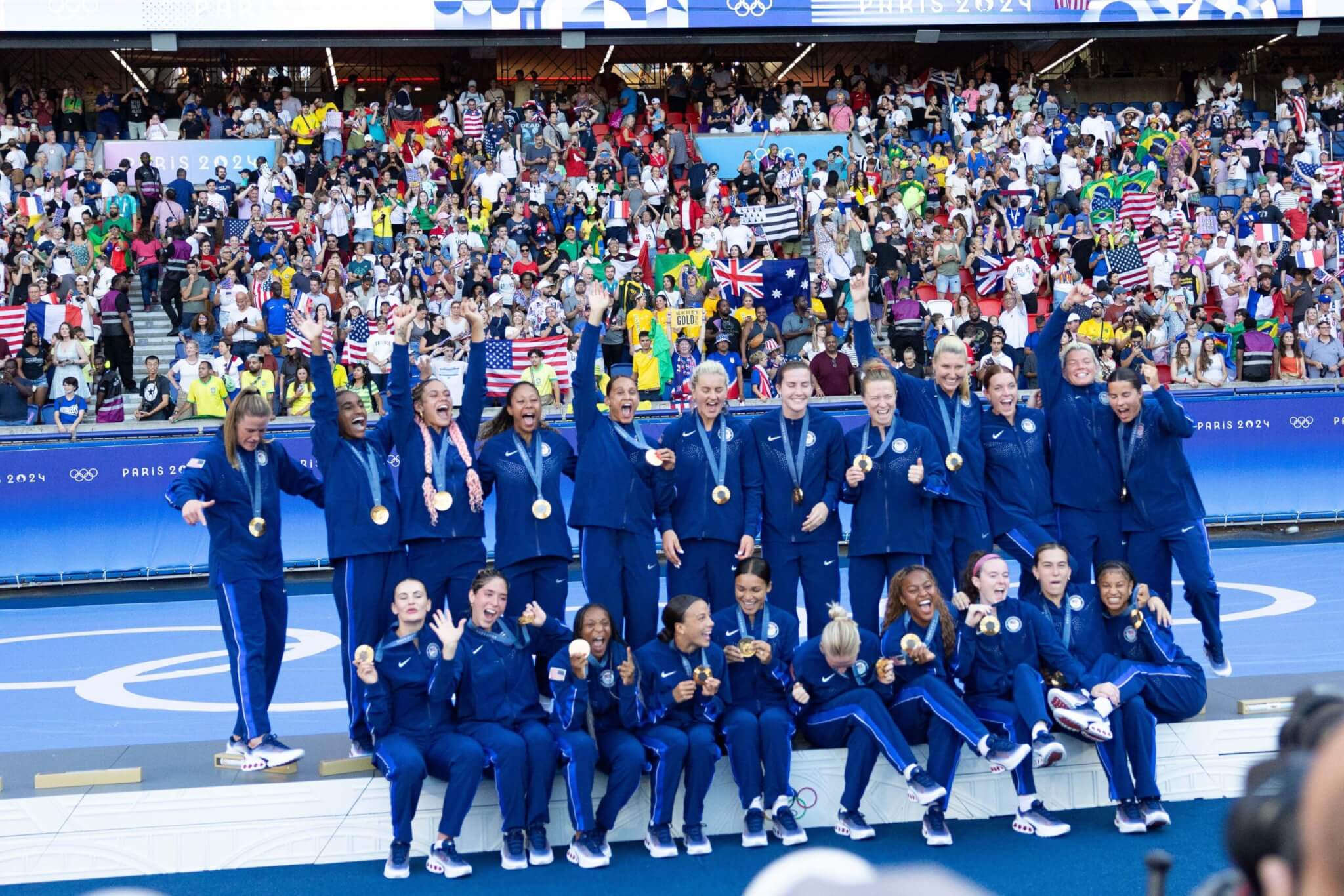
When Emma Hayes took over the United States Women’s National Team coaching job back in November of last year the hope within American supporter circles was that she could eventually bring them back to the top of the mountain.
As it turns out, eventually meant her first major tournament with the team: the 2024 Summer Olympics in Paris
Buoyed by Hayes and an array of young talent the USWNT earned their fifth Gold Medal knocking off a spirited veteran-heavy Brazil side 1-0 in the finals.
The final, much like the entire tournament, was dominated by the USWNT’s young corps of players given the keys to the starting eleven by Hayes. It was a daring proposition by the former Chelsea boss who just joined the team on June 1st. Without mainstays, Megan Rapinoe (retired), Julie Ertz (retired), and Alex Morgan (left off the roster by Hayes) the USWNT relied on the likes of Mallory Swanson, Trinity Rodman, Sophia Smith, and Naomi Girma.
That gamble paid off in particular on the attack. Swanson, Smith, and Rodman have all become regulars within the USWNT over the past few years all three were still looking for their breakout tournament. The trio now known as The Triple Espresso added a jolt of energy to the US, taking what had been a major point of concern heading into Paris and turning it on its head. The trio combined to score ten of the team’s twelve goals with Swanson slamming home the game-winner against Brazil. While the US’ attacking efforts were impressive, they were equally deadly on the defense. Led by Girma, the US allowed just two goals throughout their Olympic run including three consecutive shutouts in the knockout rounds over Japan (1-0), Germany (1-0), and Brazil. Working alongside Tierna Davidson, Crystal Dunn, and Emily Sonnett Girma imposed a tight, consistent backline that gave attackers little to work with and made Alyssa Naerher’s life much easier between the posts.
Where the Women’s World Cup is typically seen at the end of a cycle, the Summer Olympics normally held one year later is seen as the start of something new. It is a tournament that the United States has used to jumpstart the next generation of players and prepare them for the next World Cup cycle.
That balancing act of cycling in new players to go with veterans rests on the shoulders of Hayes, who expertly mastered lineup decisions through the Olympics. Facing injuries to Davidson, Sonnett, and Rose LaVelle she managed to continue to get the most out of all three while keeping their risk of increased injury at bay. Korbin Albert and Sam Coffey in the midfield, and Jenna Nighswonger in the defense were all called upon to spell veteran members of the team and flourished with their additional time on the field.
Having Lindsay Horan also helped in that process of blending two different generations of players and turning the USWNT into one strong eleven. A lone bright spot in their disastrous run at the World Cup in Australia and New Zealand, Horan thrived with the captain’s armband in Paris working to create a tightly knit midfield and connect the defense with the attack. Although she didn’t score, she didn’t need to and could focus her efforts on building rather than creating goal-scoring opportunities.
The USWNT may have won the Gold Medal, but they are still in a different women’s soccer world than in year’s past. But there is a sharpness to this group, a chip on their shoulder that comes with having something to prove. That emotion and sentiment should worry the other contenders as another World Cup cycle starts and Hayes, The Triple Espresso, Girma, and the rest of this new USWNT look to build off of their Gold Medal.